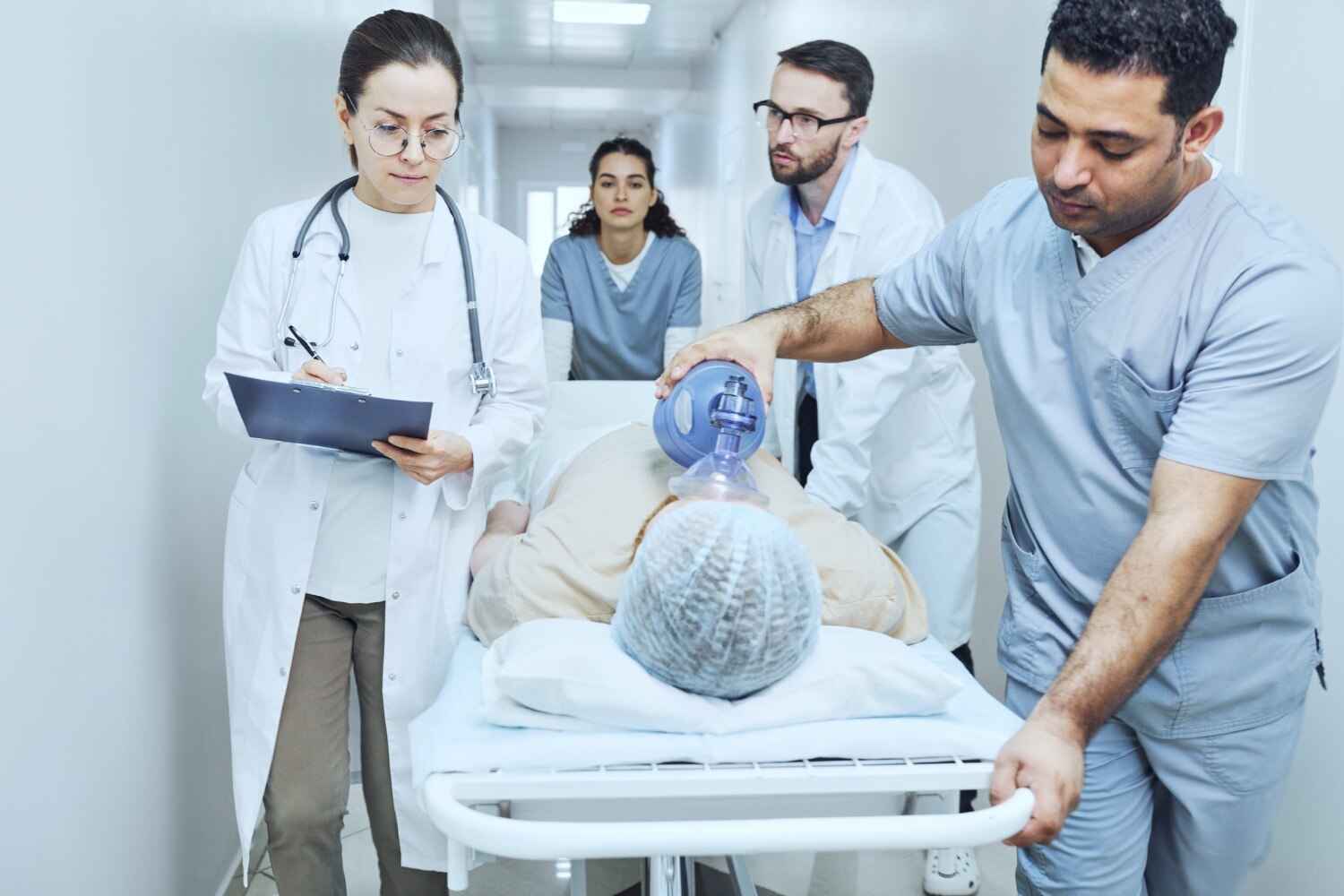
After an injury, the right first destination depends on bleeding, breathing, circulation, consciousness, function and the possibility of internal damage—not simply on whether you can find a general surgeon. You will learn when to call 112, what to do before transport, how trauma and surgical teams divide care, and how to assess emergency capability in a hospital.
Key takeaways
- Choose trauma assessment for unstable injuries or threats to organs, limbs or essential functions.
- Call an ambulance for severe bleeding, breathing problems, shock, unconsciousness or suspected spinal injury.
- Do not give food or drink when emergency surgery or anaesthesia is possible.
- Check for 24-hour imaging, blood products, anaesthesia, operating rooms and intensive care.
When an injury needs trauma care instead of a routine surgical appointment
Choose immediate trauma assessment, not a routine surgical appointment, if the patient’s condition is unstable or the injury threatens an organ, limb or essential function. Trauma care in Bengaluru is a coordinated emergency system involving triage, resuscitation, imaging, anaesthesia, surgery, blood products and intensive care—not simply a surgeon’s title.
Seek emergency help for:
- Uncontrolled bleeding, fainting, cold clammy skin, breathing difficulty or other signs of shock
- Severe abdominal pain after blunt impact, abdominal swelling or repeated vomiting
- Confusion, seizure, loss of consciousness, severe headache or neck pain
- An open fracture, visible bone, limb deformity, deep wound or suspected chest injury
- Loss of movement or sensation, pale or cold skin beyond the injury, or a weak pulse
A small-looking wound still needs emergency assessment when it lies over a joint or could have injured a tendon, nerve, artery or bone. Do not rely on superficial closure.
| Route | What it provides | When it applies |
|---|---|---|
| Trauma care | Coordinated assessment and rapid access to multiple specialists | Unstable patients, major injuries or possible internal damage |
| Routine surgical consultation | Planned examination and scheduling with one service | Stable, uncomplicated wounds without warning signs |
| General surgeon in Bengaluru | Abdominal, chest, soft-tissue and some vascular operations | Appropriate when those injuries are present; not a substitute for orthopaedic trauma, neurosurgery, burns, plastic or hand surgery |
When comparing trauma care or a general surgeon in Bengaluru, choose the service that can provide definitive treatment, not merely the earliest appointment.
What to do before transport—and when to call an ambulance
Call 112 rather than drive to a surgical hospital in Nagarabhavi when the patient is unconscious, has uncontrolled bleeding, severe breathing difficulty, shock, a suspected spine injury, major burns or multiple injuries. Ambulance transport brings trained help en route and avoids losing time at a facility that cannot provide emergency surgery in Nagarabhavi.
1. Control visible bleeding with firm, continuous pressure through a dressing. If blood soaks through, place another dressing on top; do not lift the first one to inspect the wound.
2. Do not probe the wound or pull out glass, metal or another embedded object. Use a tourniquet only for life-threatening limb bleeding that direct pressure cannot control, or when pressure is impractical.
3. Keep a suspected fracture still in the position found. Do not straighten a deformed limb, and avoid unnecessary movement after a head, neck or spine injury.
4. Keep the patient warm while waiting and watch breathing and alertness. Do not give food or drink when surgery is possible, because anaesthesia can increase aspiration risk.
Fasting must never delay the ambulance call, transport or bleeding control. Emergency teams can manage anaesthesia risks even after the patient has eaten. If the injury is stable but could need an operation, arrange same-day emergency assessment rather than a routine appointment.
How trauma teams and general surgeons share responsibility
When no single specialist can manage the injury, a coordinated trauma team shares the case. Emergency clinicians triage the patient and begin the primary survey: airway with cervical-spine protection, breathing, circulation and haemorrhage control, neurologic status, then exposure while preventing hypothermia.
- A general surgeon in Bengaluru may operate on abdominal, chest, soft-tissue and some vascular injuries.
- An orthopaedic surgeon manages fractures, crushed tissue and threatened limbs.
- A neurosurgeon manages brain and spine injuries.
- Anaesthesia secures the airway and supports the operation; radiology guides diagnosis or intervention, the blood bank provides blood products, and intensive care corrects shock and supports recovery.
The scan decision depends on stability.
| Pathway | What happens | Why |
|---|---|---|
| Unstable with suspected internal bleeding | Immediate operation or interventional treatment may proceed without every image | Waiting for scans can prolong fatal blood loss |
| Stable after resuscitation | Contrast CT maps injuries | Results help choose observation, embolisation or surgery |
Triage includes vital signs, repeated examinations and blood tests such as haemoglobin, blood group and crossmatch, clotting studies, electrolytes and lactate. Anaesthesia reviews airway risk, blood loss and medical history. Clinicians seek consent from the patient or authorised decision-maker, but consent discussions and imaging must not delay life-saving treatment when the patient cannot safely wait.
This coordinated model is what to look for in trauma care in Bengaluru, rather than a surgeon’s title alone.
Emergency, urgent or delayed surgery: what waiting changes
Emergency surgery treats an immediate threat; urgent surgery follows stabilisation; delayed surgery waits until observation, swelling reduction or recovery makes repair safer.
| Type | What waiting changes | Examples |
|---|---|---|
| Emergency | Delay can cause death or permanent loss of function | Uncontrolled internal bleeding, perforation, blocked airway, or limb-threatening loss of blood flow |
| Urgent | Infection, tissue loss or instability can progress after initial resuscitation | Open fracture, contaminated deep wound, or worsening abdominal injury |
| Delayed or elective | Time allows swelling to settle, other injuries to recover, or a planned repair to be safer | Selected fractures, soft-tissue reconstruction, or abdominal repair after observation |
There is no universal one-hour rule. Rapid transport and early haemorrhage control matter, but the sequence depends on your physiology, injury pattern, prehospital treatment and available expertise. A stable patient may need contrast CT, embolisation or observation instead of immediate surgery.
Damage-control surgery is used when severe trauma makes a long operation dangerous. Surgeons quickly control bleeding and contamination, pack or temporarily close the area, then intensive care corrects hypothermia, acidosis and coagulopathy before a later operation completes reconstruction.
Do not wait at home or book a routine appointment after serious injury. Bleeding, infection, compartment syndrome, brain swelling or bowel damage can worsen quietly.
A search for emergency surgery Nagarabhavi should lead to immediate emergency assessment, not a scheduled consultation; the right trauma care or general surgeon in Bengaluru depends on the injury and the team available.
How to judge emergency readiness before choosing a hospital
A hospital is emergency-ready only if it can assess, stabilise and operate on an injured patient at any hour—not merely advertise surgery. A surgical hospital Nagarabhavi search result or routine surgery list does not prove continuous trauma readiness.
Ask the hospital to confirm:
- 24-hour emergency registration and triage
- Resuscitation, anaesthesia and emergency general-surgery coverage
- CT and X-ray access, blood-bank access, an operating room and ICU beds
- Orthopaedic, neurosurgical or other specialist backup relevant to the injury
- The transfer process for cases exceeding its capability
| Capability | What to verify | Why it matters |
|---|---|---|
| Emergency team | Doctor and resuscitation staff available 24/7 | Stabilisation cannot wait for office hours |
| Diagnostics | CT and X-ray available urgently | Imaging guides surgery or transfer |
| Definitive care | Anaesthesia, operating room, blood products and ICU beds | A scan is useless if treatment cannot follow |
| Specialist backup | Orthopaedics, neurosurgery or other relevant services | A general surgeon cannot manage every brain, spine or complex limb injury |
For someone comparing trauma care or general surgeon in Bengaluru, judge the whole system, not a doctor’s title. ABHANI LAKEVIEW HOSPITAL can be considered when its emergency, surgical, diagnostic and critical-care teams match the patient’s needs; call first to confirm current availability.
Ask how and where transfer occurs if the hospital cannot provide definitive treatment. For an unstable or seriously injured patient, call 112; for a stable injury with possible surgical damage, seek same-day emergency assessment rather than waiting for a routine consultation.
Related service
GENERAL SURGERY Abhani Hospitals is a trusted destination for advanced General Surgery treatment in Nagarbhavi, Bangalore, offering expert care for a wide range of... View service → |
Frequently asked questions
When does an injury need trauma care instead of a routine surgical appointment?
Choose immediate trauma assessment when the patient is unstable or the injury threatens an organ, limb or essential function. Warning signs include severe bleeding, breathing difficulty, unconsciousness, shock, major burns, suspected spinal injury or a mangled limb.
What should you do before transporting someone with a serious injury?
Call an ambulance for severe or life-threatening injuries. Apply firm pressure to external bleeding, keep the person still and warm, avoid removing embedded objects, and do not give food or drink when emergency surgery or anaesthesia is possible.
How do trauma teams and general surgeons share responsibility?
The trauma team coordinates triage, resuscitation, imaging, anaesthesia, blood products and intensive care. A general surgeon assesses and treats injuries that fall within surgical expertise while coordinating with other specialists when needed.
What changes when surgery is emergency, urgent or delayed?
Emergency surgery addresses immediate threats such as uncontrolled bleeding or perforation. Urgent surgery follows rapid stabilisation and assessment. Delayed surgery is appropriate only when waiting does not increase the risk of infection, organ damage, blood loss or loss of function.
How can you judge a hospital’s emergency readiness before choosing it?
Ask whether the hospital provides 24-hour emergency assessment, imaging, anaesthesia, operating-room access, blood products and intensive care. Confirm how it manages trauma transfers and whether surgical and critical-care teams can respond at any hour.
Keywords