
A hospital’s “super speciality” label does not tell you whether it is the right place for a hernia repair, appendicitis, gallbladder operation or suspected abdominal cancer. You will be able to match the condition to the right surgeon, compare hospitals on operating and recovery capability, and ask questions that expose important differences in safety, cost and follow-up.
Key takeaways
- Use a general surgeon for common abdominal, soft-tissue, thyroid and breast conditions.
- Choose specialist care when the diagnosis requires organ-specific expertise or complex treatment.
- Compare emergency support, anaesthesia, ICU, infection control and follow-up—not labels alone.
- Ask about laparoscopic, open and robotic options, including risks, recovery and total cost.
Which problems belong to general surgery, and which need a specialist?
A general surgeon evaluates and treats many conditions involving the abdomen, skin, soft tissue, breast, thyroid and digestive tract. A multispeciality hospital brings several departments under one roof; a super speciality hospital in Bengaluru focuses on advanced care in selected fields.
The label does not replace an examination, imaging, blood tests or review by the relevant surgeon.
| Presentation | Usual first service | When focused referral matters |
|---|---|---|
| Hernia, appendicitis, gallbladder disease | General surgeon | Strangulation, severe infection or complex previous operations |
| Piles, abscesses, thyroid lumps | General surgeon | Recurrent disease, suspicious thyroid findings or cancer concern |
| Abdominal mass | General surgeon | Possible cancer or disease involving a specific organ |
| Brain, spine or nerve disorder | Neurosurgeon | Direct specialist assessment is required |
| Urinary or male reproductive problem | Urologist | Kidney stones, prostate, bladder, testicular or fertility conditions |
| Complex digestive, liver or colorectal disease | Gastroenterologist or focused surgeon | Inflammatory bowel disease, liver disease, colorectal cancer or major reconstruction |
A general surgeon can diagnose, operate on straightforward hernias, abscesses, appendicitis and gallbladder disease, then coordinate referral when the case exceeds the team’s scope. Ask a “general surgeon near me” about the affected organ, suspected complexity, prior operations and available critical care—not only the hospital name.
For bowel obstruction, perforation, a strangulated hernia or uncontrolled bleeding, compare travel time during a real emergency. Ask whether the hospital has an overnight surgeon, anaesthetist and operating team physically available.
How should you choose between general surgery and super-specialist care?
A general surgeon is a sensible first choice when the diagnosis is clear, the affected organ is within general surgery, and the operation is routine. A straightforward hernia repair, abscess drainage, appendicitis or gallbladder operation can often be managed independently after assessment.
| Choose general surgery | Seek super-specialist input |
|---|---|
| Confirmed, uncomplicated condition | Uncertain diagnosis, complex anatomy or cancer suspicion |
| Stable patient needing routine repair | Brain, spine or nerve disease needing a neurosurgeon |
| No major previous operation | Urinary or male reproductive disease needing a urologist |
| Standard anaesthesia and ward recovery | Complex digestive, liver or colorectal disease needing a gastroenterologist or focused surgeon |
Referral is safer for an abdominal mass with possible cancer, extensive adhesions after previous operations, recurrent disease, difficult anatomy, or a likely need for high-dependency or intensive care. Ask for an oncological surgeon or multidisciplinary team when cancer is suspected; the first operation can affect later treatment.
Urgency can outweigh specialisation. Suspected bowel obstruction, perforation, strangulated hernia or uncontrolled bleeding needs immediate assessment and sometimes emergency surgery, so compare travel time during traffic, not only map distance. Search results for “general surgeon near me” are not enough.
Before choosing a general surgery hospital in Nagarabhavi, ask whether an overnight surgeon, anaesthetist and operating team are physically available. An emergency-care claim does not prove that they are on site. If they are not, choose the facility that can assess, operate and escalate without a dangerous transfer.
What should you compare beyond the words “super speciality”?
A useful comparison asks what happens at 2 a.m., not which hospital has the grander label. Use this checklist to compare surgery hospitals:
| Capability | Ask the hospital | Why it matters |
|---|---|---|
| Emergency and surgeons | Is a surgeon, anaesthetist and operating team physically available 24 hours? | Delayed treatment can worsen bleeding, perforation or obstruction. |
| Operating theatres | Is an emergency theatre available overnight? | A booked elective theatre does not guarantee emergency access. |
| ICU and HDU | How many beds support escalation after surgery? | A patient can need ventilation, blood pressure support or closer observation. |
| Diagnostics | Are imaging and laboratory services available 24 hours? | Waiting for a scan or blood result can delay surgery. |
| Blood and infection control | Can the hospital provide red cells, plasma and platelets, and how are hand hygiene, sterilisation and antibiotic practices audited? | Blood loss and infections require immediate, controlled responses. |
| Recovery | Who monitors patients after surgery, and who handles complications after discharge? | Clear escalation is safer than an unanswered phone. |
The WHO Surgical Safety Checklist requires three pauses: before anaesthesia, before skin incision and before leaving the operating room. Ask how staff perform and document each pause.
For planned surgery, ask for documented pre-anaesthesia assessment, medication and allergy review, airway assessment, pain and nausea planning, venous-thromboembolism prevention and criteria for ICU escalation. Ask for readmission, surgical-site infection, unplanned return to theatre, conversion to open surgery and length of stay for your exact procedure—not total operation counts.
Assess ABHANI LAKEVIEW HOSPITAL by these capabilities, staffing and procedure-specific results, not its location or “super speciality hospital general surgery in Bengaluru” label.
Related service
GENERAL SURGERY Abhani Hospitals is a trusted destination for advanced General Surgery treatment in Nagarbhavi, Bangalore, offering expert care for a wide range of... View service → |
How do laparoscopic, open and robotic operations compare?
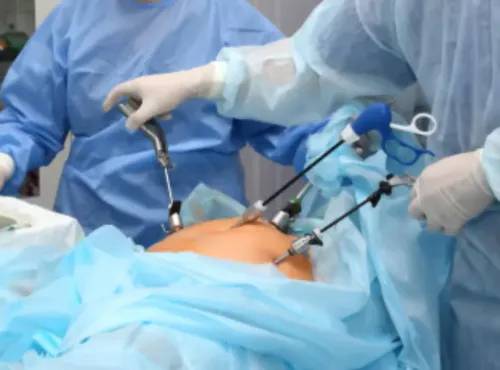
The proposed approach matters more than the label of the facility. Laparoscopic surgery uses small incisions, a camera and long instruments; open surgery uses a larger incision for direct access. Robotic surgery adds a computer-assisted instrument platform, but a trained surgeon and operating team still control the procedure.
| Option | Main advantage | When it may be unsuitable |
|---|---|---|
| Laparoscopic | Smaller wounds and often faster mobility | Unstable emergency, extensive adhesions, difficult anatomy, advanced disease or unavailable equipment |
| Open | Direct access and flexibility | Larger wound, more pain and longer recovery |
| Robotic | Computer-assisted control and instrument movement | Same surgical limitations as laparoscopy, plus equipment, cost or trained-team limits |
Minimally invasive does not automatically mean safer. Ask whether previous operations caused adhesions, whether the anatomy is difficult, and whether cancer or advanced disease changes the plan. An unstable patient may need immediate open surgery rather than a slower approach.
Every consultation should cover:
- The named operating surgeon, anaesthetist and anaesthesia plan
- The possibility of conversion to open surgery or an additional procedure
- Expected hospital stay, activity restrictions and recovery schedule
- Procedure-specific risks, including bleeding, infection, injury and reoperation
- Alternatives, including observation, medication or other non-operative management when appropriate
- What could happen if treatment is deferred
Use these answers to compare surgery hospitals, not just to choose a super speciality hospital in Bengaluru. Ask how the team uses the WHO pauses before anaesthesia, before incision and before leaving the operating room.
What must you verify before booking surgery or leaving hospital?
A lower hospital price or “super speciality” label does not settle the decision. To compare a general surgeon near me with specialist options, verify the person, procedure, emergency support and total cost in writing.
1. Ask for the exact diagnosis, urgency, proposed procedure and reason for choosing a general surgeon or super-specialist. For a general surgery hospital in Nagarabhavi, ask whether the named surgeon will personally operate or supervise, and whether procedure-specific experience covers your operation.
2. Check the surgeon’s registration through the National Medical Register or the applicable state medical council. Confirm the anaesthetist, overnight surgical cover and operating team for emergencies rather than assuming an emergency-care advertisement means they are physically available.
3. Obtain written informed consent and an itemised estimate separating the surgeon, anaesthetist, operating room, mesh or implant, pathology, imaging, room, pharmacy, ICU and complication-related charges. Ask what the package excludes.
4. Before day-care discharge, confirm stable vital signs, controlled pain and nausea, adequate mobility, ability to drink or pass urine where relevant, supervision at home and written instructions. Same-day discharge is unsafe without these checks.
5. Leave with a named follow-up contact, a 24-hour escalation route, access to your records and discharge instructions. Ask exactly where to call for fever, wound opening, persistent vomiting, jaundice or worsening pain, and when to return immediately.
Frequently asked questions
Which problems belong to general surgery, and which need a specialist?
General surgeons commonly assess abdominal conditions, hernias, gallbladder disease, appendicitis, skin and soft-tissue problems, breast conditions and some thyroid disorders. Seek a specialist when the condition requires organ-specific expertise, complex cancer treatment, advanced cardiac or neurological care, or another focused discipline.
How should you choose between general surgery and super-specialist care?
Start with the diagnosis and the operation required, then match the surgeon’s training and case experience to that problem. Choose a hospital with the emergency, anaesthesia, intensive-care and specialist backup your condition could require.
What should you compare beyond the words “super speciality”?
Compare the surgeon’s relevant experience, 24-hour emergency cover, anaesthesia team, ICU, infection-control practices, imaging, blood-bank access, pathology, accreditation details and follow-up arrangements.
How do laparoscopic, open and robotic operations compare?
Laparoscopic surgery uses small incisions and a camera, open surgery uses a larger incision, and robotic surgery uses instruments controlled by the surgeon. Ask which approach fits your condition, expected recovery, risks, availability and total bill.
What must you verify before booking surgery or leaving hospital?
Before booking, confirm the diagnosis, proposed procedure, surgeon, anaesthetist, itemised estimate, consent process and follow-up plan. Before leaving, collect the discharge summary, prescriptions, test results, wound-care instructions, warning signs and emergency contact number.
Keywords